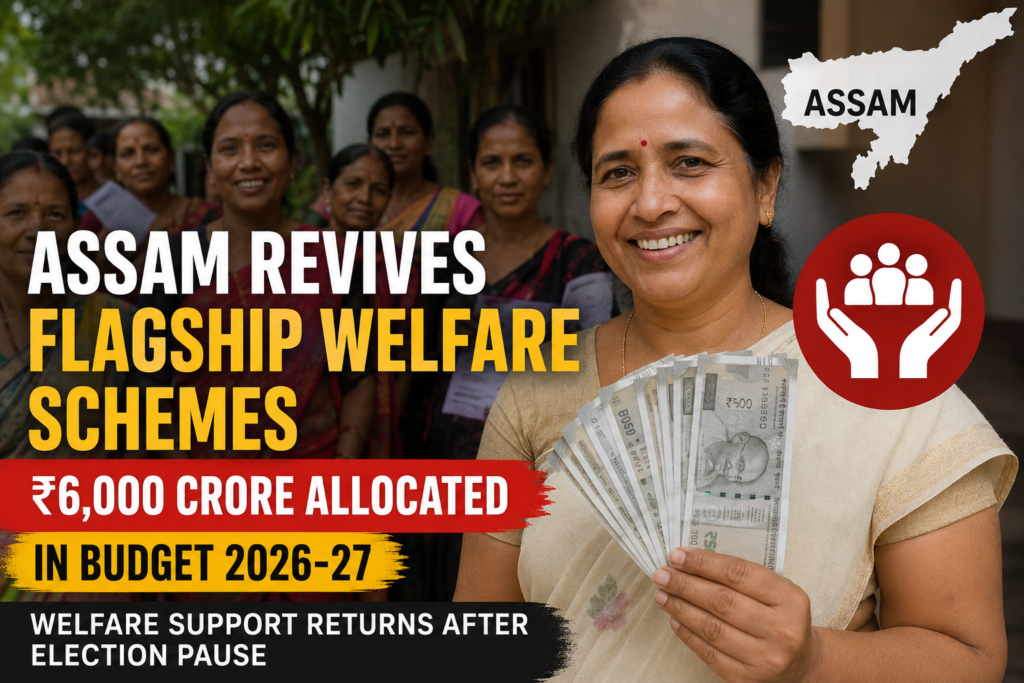
The Assam Government has announced a major revival of its flagship welfare programmes in the Assam Budget 2026–27 by allocating more than ₹6,000 crore to restart several beneficiary-oriented schemes that were temporarily paused during the election period. The announcement is one of the most significant social welfare decisions in the state’s latest budget and reflects the government’s intention to restore financial assistance to millions of eligible residents while maintaining fiscal responsibility. The temporary suspension of many schemes during the election season was linked to the enforcement of the Model Code of Conduct, which limits governments from introducing or expanding welfare initiatives that could influence voters. With the elections now over, the government has resumed these programmes with fresh budgetary support, revised implementation strategies, and greater emphasis on transparency and efficient beneficiary identification. The revival is expected to strengthen rural livelihoods, improve household income security, support women and vulnerable families, and contribute to the state’s overall economic growth.
Assam Budget 2026–27 Welfare Schemes Insights
| Particular | Details |
|---|---|
| State | Assam |
| Financial Year | 2026–27 |
| Welfare Allocation | Over ₹6,000 crore |
| Purpose | Revival of beneficiary-oriented welfare schemes |
| Reason for Earlier Suspension | Election Model Code of Conduct |
| Major Focus Areas | Women, low-income families, youth, rural development and social welfare |
| Budget Presented By | Finance Minister Jayanta Malla Baruah |
| Status | Welfare schemes revived |
| Expected Impact | Millions of beneficiaries across Assam |
Why Were the Welfare Schemes Paused Earlier?
Many residents noticed that approvals, registrations, and payments under several welfare programmes slowed down during the election period. This happened because the Election Commission’s Model Code of Conduct came into force after the election schedule was announced. The code ensures a fair electoral process by preventing governments from launching new welfare benefits or making financial announcements that could influence voters. While some ongoing administrative work continues during this period, fresh approvals and financial releases are often postponed until elections conclude. As a result, many welfare programmes in Assam experienced temporary delays before returning to normal after the election process ended.
What Has Changed in the Assam Budget 2026–27?
The latest budget goes beyond simply restoring funding. It introduces a renewed commitment to strengthening Assam’s welfare system by providing more than ₹6,000 crore for beneficiary-oriented schemes while also improving administrative efficiency. The government has indicated that departments will resume pending financial assistance, process delayed applications, and continue implementing welfare initiatives with better monitoring systems. The budget also focuses on improving accountability by strengthening eligibility verification, updating beneficiary databases, and reducing duplication or misuse of public funds.
Why Is the ₹6,000 Crore Allocation Significant?
An allocation of more than ₹6,000 crore represents a substantial investment in Assam’s social welfare sector. Such a large commitment highlights the government’s focus on improving the lives of economically weaker sections while supporting inclusive development. Welfare spending directly benefits households by providing financial assistance for education, healthcare, livelihood support, and social security. It also contributes to local economic activity because beneficiary families spend this assistance within their communities, helping small businesses, local markets, and service providers.
How Welfare Spending Supports the State Economy
Government welfare programmes play an important role in both social protection and economic development. Financial assistance received by eligible families is commonly used for essential expenses such as food, education, healthcare, transportation, farming, and household needs. This spending increases demand in local markets and creates opportunities for small traders, retailers, transport operators, and other businesses. As money circulates through the economy, it generates a multiplier effect that benefits both rural and urban areas. Therefore, welfare expenditure serves not only as financial support for individuals but also as an important driver of economic activity.
Objectives Behind Restarting the Welfare Schemes
The decision to restart welfare schemes serves several important purposes. It restores support to beneficiaries who experienced delays during the election period, improves public confidence in government programmes, strengthens financial security for vulnerable households, and ensures continuity in long-term social development initiatives. By reviving these schemes quickly after the elections, the government also aims to reduce administrative backlogs and accelerate the delivery of benefits to eligible citizens.
Government’s Focus on Better Targeting
The revival of welfare programmes is accompanied by a stronger emphasis on identifying genuine beneficiaries. The government plans to improve verification systems through updated databases, better coordination among departments, and enhanced digital monitoring. These measures are intended to ensure that benefits reach deserving families while reducing errors, duplicate registrations, and misuse of public funds. Improved transparency is expected to increase public trust in government welfare programmes over the coming years.
Impact on Women and Vulnerable Families
Women remain among the primary beneficiaries of many state welfare schemes. Financial assistance provided to women often contributes directly to children’s education, family healthcare, household nutrition, and savings. The revival of welfare programmes is expected to strengthen financial independence for women while also supporting elderly citizens, persons with disabilities, low-income households, and other socially vulnerable groups. Better access to financial assistance can significantly improve the quality of life for families facing economic challenges.
Expected Impact on Rural Assam
The greatest impact of these revived schemes is likely to be seen in rural Assam, where many households depend on government assistance as a supplementary source of income. Farmers, agricultural labourers, daily wage workers, self-help groups, and economically weaker families often rely on welfare programmes to manage seasonal expenses and essential household costs. The resumption of financial assistance is expected to increase rural purchasing power, stimulate local markets, and support economic recovery in villages across the state.
Employment and Welfare: A Connected Strategy
The Assam Budget 2026–27 combines welfare spending with broader development goals such as employment generation, industrial growth, infrastructure expansion, and skill development. Rather than treating welfare and employment as separate policies, the government appears to be adopting a balanced approach where financial assistance provides short-term support while investments in jobs and industries create long-term opportunities. This integrated strategy aims to improve both immediate living conditions and future economic prospects.
Statistical Snapshot
| Indicator | Latest Information |
|---|---|
| Welfare Allocation | ₹6,000+ crore |
| Budget Year | 2026–27 |
| Election Pause | During Model Code of Conduct |
| Current Status | Schemes revived |
| Administrative Focus | Improved beneficiary targeting |
| Expected Coverage | Millions of eligible beneficiaries |
Timeline of Recent Developments
| Period | Development |
|---|---|
| Election Period | Welfare implementation slowed due to Model Code of Conduct |
| Post Election | Administrative review of schemes |
| Budget 2026–27 | Allocation of over ₹6,000 crore announced |
| Current Phase | Welfare schemes being restarted |
Challenges That May Continue
Although the budget allocation provides strong financial support, successful implementation will depend on efficient administration. Departments must ensure timely verification of beneficiaries, smooth fund transfers, updated records, effective grievance redressal, and coordination among various government agencies. Citizens may also need to update their documents or complete verification requirements to continue receiving benefits without interruption. Addressing these administrative challenges will be essential for achieving the intended impact of the revived welfare programmes.
Fiscal Perspective
Every government must balance welfare spending with investments in infrastructure, healthcare, education, agriculture, and economic development. By allocating over ₹6,000 crore to welfare programmes, Assam has demonstrated its commitment to social protection while continuing broader development initiatives. However, maintaining this level of welfare spending over the long term will require careful financial planning, efficient resource management, and sustainable revenue generation to ensure that future commitments remain financially viable.
Political Significance of the Decision
Large-scale welfare programmes often carry political significance because they directly affect millions of citizens. Restarting these schemes immediately after the election period demonstrates the government’s intention to continue supporting public welfare while fulfilling its budget commitments. At the same time, the long-term success of these initiatives will depend less on announcements and more on effective implementation, timely payments, transparent eligibility criteria, and responsive grievance mechanisms.
Broader Development Context
The revival of welfare schemes forms one part of Assam’s broader development strategy for the financial year 2026–27. Alongside social welfare spending, the budget includes measures aimed at promoting industrial investment, employment generation, infrastructure development, education, healthcare, agriculture, and digital governance. Together, these initiatives indicate a comprehensive approach to economic growth that combines immediate social support with long-term development planning.
Important Dates
| Event | Date/Status |
|---|---|
| Welfare Scheme Pause | During Election Period |
| Assam Budget Presentation | Financial Year 2026–27 |
| Welfare Revival Announcement | Budget 2026–27 |
| Budget Allocation | Over ₹6,000 crore |
| Implementation | To continue through concerned departments |
What Beneficiaries Should Do
Eligible citizens should continue monitoring official announcements issued by their respective government departments regarding registrations, verification, updated eligibility criteria, and payment schedules. Individuals whose applications remained pending during the election period should verify whether additional documentation or updated verification is required so that benefits can be released without unnecessary delays. Staying informed through official government channels will help beneficiaries avoid misinformation and complete all required formalities on time.
FAQs
1. Why were Assam’s welfare schemes paused?
The schemes were temporarily delayed because of the Election Commission’s Model Code of Conduct, which restricts governments from introducing or expanding welfare programmes during elections.
2. How much has Assam allocated for welfare schemes in Budget 2026–27?
The Assam Government has allocated more than ₹6,000 crore for restarting beneficiary-oriented welfare schemes across the state.
3. Will all previous beneficiaries automatically receive benefits?
Eligible beneficiaries may need to complete verification or update their records if required. Individual departments will issue detailed implementation guidelines.
4. Who is expected to benefit the most?
Women, economically weaker families, senior citizens, rural households, farmers, and other eligible beneficiaries covered under various state welfare schemes are expected to benefit.