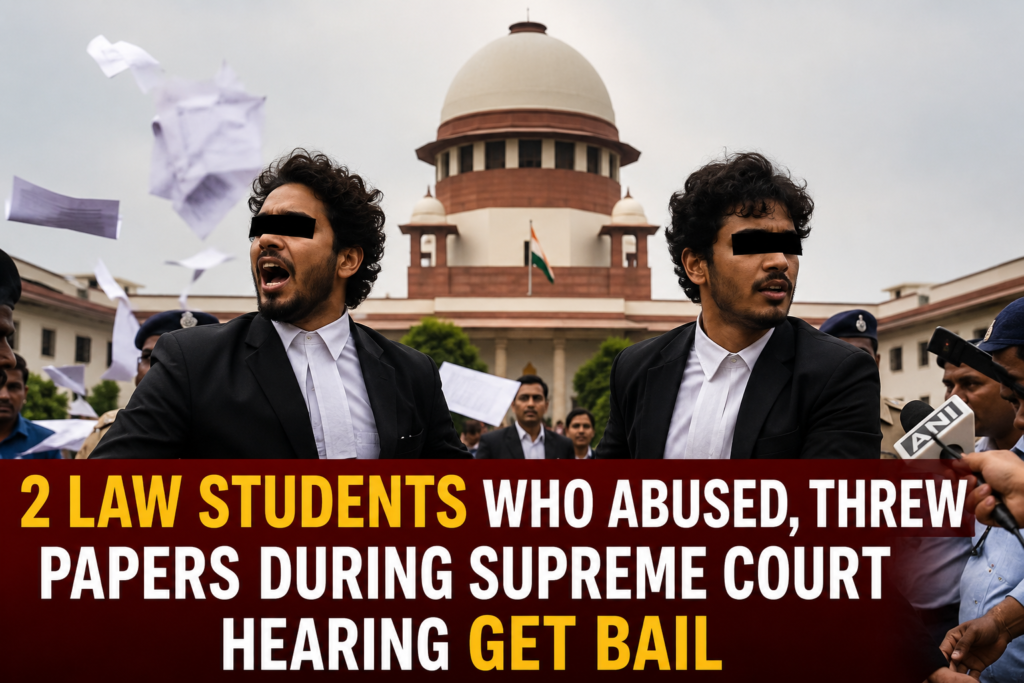
The case involving two law students who allegedly abused judges and threw papers during a Supreme Court hearing before later being granted bail has drawn nationwide attention, raising serious questions about courtroom discipline, respect for judicial institutions, and the balance between individual rights and maintaining the dignity of the justice system. The incident quickly became one of the most discussed legal developments, with lawyers, law students, legal experts, and the public debating whether the actions amounted to contempt of court and what consequences should follow.
The Supreme Court has always emphasized that courtrooms are places where justice is administered through decorum, discipline, and adherence to legal procedures. Any disruption during proceedings is viewed seriously because it can interfere with the administration of justice. While the granting of bail provides temporary relief to the accused students, the legal proceedings are expected to continue in accordance with the law. The incident also serves as an important reminder for aspiring lawyers about professional ethics and courtroom conduct.
Quick Highlights
| Particular | Details |
|---|---|
| Incident | Two law students allegedly disrupted Supreme Court proceedings |
| Allegation | Abused judges and threw papers inside courtroom |
| Court Action | Students were taken into custody |
| Latest Update | Bail granted by the court |
| Legal Issues | Courtroom misconduct, possible contempt, criminal offences |
| Status | Investigation and legal proceedings continue |
What Happened During the Supreme Court Hearing?
According to reports surrounding the incident, two law students allegedly interrupted an ongoing Supreme Court hearing by shouting abusive remarks and throwing papers inside the courtroom. The disruption reportedly occurred while judicial proceedings were underway, forcing security personnel and court officials to intervene immediately. Such incidents are extremely rare in India’s highest court because access to courtrooms is tightly regulated and visitors are expected to maintain complete discipline throughout the proceedings. The disruption quickly attracted widespread attention due to its unprecedented nature and the seriousness attached to any interference with judicial functions.
Why Courtroom Discipline Matters
Courtrooms function according to strict procedural rules designed to ensure fairness, impartiality, and respect for the judicial process. Every participant, including judges, lawyers, litigants, journalists, interns, and visitors, is expected to follow courtroom etiquette without exception. Any act that interrupts proceedings, intimidates participants, or undermines the authority of the court may attract legal consequences. Maintaining courtroom discipline is essential because judicial decisions affect citizens’ rights, constitutional principles, and the rule of law, making an orderly environment indispensable for justice delivery.
Bail Granted to the Two Law Students
Following their detention and subsequent legal proceedings, the two law students were granted bail by the competent court. Bail does not amount to acquittal or a declaration of innocence; rather, it permits an accused person to remain out of custody while the legal process continues, subject to conditions imposed by the court. Courts generally consider several factors before granting bail, including the seriousness of allegations, the possibility of tampering with evidence, the likelihood of fleeing justice, and the accused person’s cooperation with the investigation. The grant of bail reflects the legal principle that every accused person is presumed innocent until proven guilty in a court of law.
Possible Legal Charges in Such Cases
Although the precise charges depend on the investigation and applicable laws, incidents involving courtroom disruption can potentially lead to allegations relating to criminal intimidation, obstruction of public servants, intentional disturbance during judicial proceedings, criminal trespass where applicable, and contempt of court. The final charges are determined after examining evidence, witness statements, security footage, and the specific facts of the case. Authorities are expected to proceed according to the relevant provisions of Indian law while ensuring that due process is followed throughout the investigation.
Understanding Contempt of Court
Contempt of court refers to actions that interfere with the administration of justice or lower the authority and dignity of the judiciary. Indian law recognizes both civil and criminal contempt. Criminal contempt may include acts that scandalize the court, prejudice judicial proceedings, or obstruct the administration of justice. However, every allegation of contempt must be examined carefully within the legal framework, and courts provide individuals with an opportunity to present their defence before arriving at any conclusion. The objective of contempt jurisdiction is not punishment alone but preserving public confidence in the judicial system.
Supreme Court Security Measures
The Supreme Court of India maintains multiple layers of security to ensure the safety of judges, advocates, litigants, and visitors. Entry into the premises generally requires prior authorization, security screening, identity verification, and compliance with court regulations. Courtroom marshals and security personnel remain present to respond immediately if any disruption occurs. Following incidents that disturb judicial proceedings, authorities often review existing security arrangements and may recommend additional safeguards to prevent similar occurrences in the future while ensuring public access to justice remains unaffected.
Responsibilities of Law Students
Law students are expected to uphold the highest standards of integrity, professionalism, and ethical conduct because they represent the future of the legal profession. Court visits are considered valuable educational experiences that help students understand judicial procedures, advocacy, and constitutional values. Educational institutions frequently emphasize courtroom etiquette, respectful communication, and professional behaviour, as these qualities form the foundation of responsible legal practice. Incidents involving law students naturally attract greater public attention because society expects future lawyers to demonstrate respect for legal institutions.
Ethical Standards in the Legal Profession
Professional ethics occupy a central place in legal education and legal practice. Lawyers are officers of the court and are expected to assist in the administration of justice while maintaining honesty, dignity, and respect toward judges, opposing counsel, and litigants. Legal ethics also require advocates to avoid conduct that could undermine public confidence in the judicial system. Law schools across India regularly organize seminars, moot courts, and professional responsibility courses to familiarize students with these obligations long before they begin practicing law.
Public Reaction to the Incident
The reported incident generated significant discussion across social media platforms and legal circles, with many expressing concern over the alleged disruption inside the country’s highest court. Some commentators emphasized the importance of maintaining courtroom discipline regardless of personal opinions, while others highlighted the importance of ensuring that legal proceedings against the accused remain fair and unbiased. The debate also sparked broader conversations about legal education, youth activism, freedom of expression, and the limits of protest within judicial institutions.
Legal Experts’ Perspective
Many legal experts have observed that while criticism of judicial decisions is permissible within constitutional limits, disruption of court proceedings is fundamentally different because it may obstruct the administration of justice. Experts also note that the grant of bail reflects established constitutional principles protecting personal liberty and should not be interpreted as a final determination of guilt or innocence. The case underscores the need to distinguish between lawful expression of disagreement and conduct that allegedly interferes with judicial functioning.
The Difference Between Bail and Acquittal
One of the most common misconceptions surrounding criminal proceedings is that obtaining bail means the accused has been cleared of all allegations. In reality, bail is simply a temporary legal arrangement allowing an accused person to remain free while the investigation or trial continues. An acquittal, by contrast, occurs only after the court evaluates evidence, hears arguments, and concludes that the prosecution has failed to establish guilt beyond reasonable doubt. Therefore, the grant of bail in this case does not determine the final outcome of the proceedings.
Constitutional Principles Involved
The case highlights several constitutional principles operating simultaneously within India’s legal system. On one hand, the judiciary must preserve the sanctity of court proceedings and ensure that justice is administered without obstruction. On the other hand, every accused individual enjoys constitutional protections including the presumption of innocence, access to legal representation, and the right to a fair trial. Courts strive to balance institutional authority with individual liberties while ensuring that legal processes remain transparent and impartial.
Impact on Legal Education
The incident has prompted renewed discussion among law colleges regarding the importance of professional responsibility and courtroom etiquette. Many educational institutions already conduct orientation sessions before students visit courts, explaining appropriate behaviour, dress codes, and the consequences of violating courtroom rules. Such programs may receive greater emphasis following this case, encouraging students to appreciate that legal advocacy must always operate within the framework of respect, discipline, and constitutional values.
What Happens Next in the Case?
Following the grant of bail, the legal process is expected to continue through investigation, filing of relevant documents, examination of evidence, and subsequent court hearings. Depending on the findings, the prosecution and defence will present their respective arguments before the competent court. The final outcome will depend entirely on the evidence produced and judicial findings during the course of the proceedings. Until then, all allegations remain subject to adjudication through the due process established under Indian law.
Importance of Respecting Judicial Institutions
The judiciary plays a critical role in protecting constitutional rights, resolving disputes, and maintaining the rule of law. Respect for judicial institutions does not prevent constructive criticism of judgments or legal principles, but it requires that disagreements be expressed through lawful and peaceful means. Maintaining order inside courtrooms ensures that every litigant receives a fair hearing and that judicial proceedings continue without unnecessary disruption. Incidents affecting courtroom decorum therefore receive careful legal scrutiny to safeguard public confidence in the justice system.
FAQs
1. Why were the two law students arrested?
They were allegedly involved in disrupting Supreme Court proceedings by using abusive language and throwing papers during a hearing. The exact allegations are subject to the ongoing legal process.
2. Have the students been acquitted?
No. They have only been granted bail. The case will continue according to the legal process.
3. What does bail mean?
Bail allows an accused person to remain out of custody while the investigation or trial continues, subject to conditions imposed by the court.
4. Can disrupting court proceedings lead to legal action?
Yes. Disrupting judicial proceedings may result in criminal charges and, depending on the circumstances, contempt of court proceedings.
5. What is contempt of court?
Contempt of court refers to conduct that interferes with the administration of justice or undermines the authority of the judiciary.