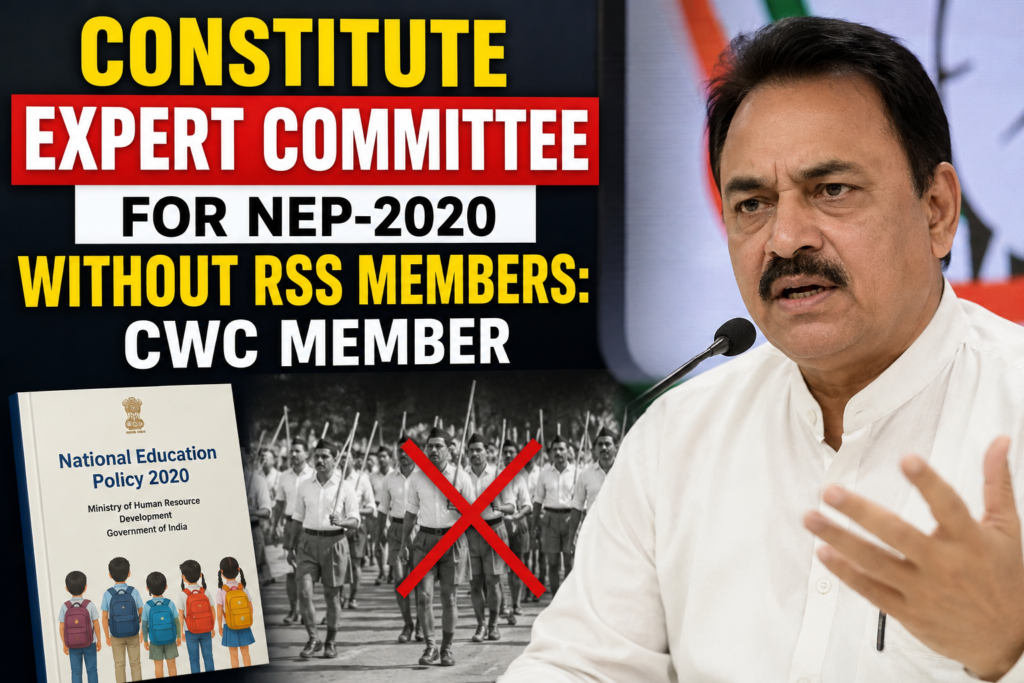
The debate surrounding the implementation of the National Education Policy (NEP) 2020 has once again taken center stage after a Congress Working Committee (CWC) member demanded the constitution of an independent expert committee without any Rashtriya Swayamsevak Sangh (RSS) members. According to the CWC leader, the review and implementation of NEP-2020 should be carried out by educationists, academicians, researchers, and policy experts who are free from political or ideological affiliations. The statement has reignited discussions over educational reforms, academic autonomy, and the role of ideological organizations in shaping India’s education system.
The National Education Policy 2020 remains one of India’s most significant educational reforms in recent decades. While the policy has received appreciation for introducing multidisciplinary learning, skill-based education, and flexibility in higher education, it has also faced criticism from opposition parties and several academic groups. The latest demand by the CWC member has intensified the political discourse, making NEP-2020 one of the most discussed education-related topics in the country.
What Is the Latest Controversy Over NEP-2020?
The recent controversy emerged after a Congress Working Committee member publicly urged the central government to establish an expert committee exclusively consisting of independent education specialists without representatives associated with the RSS. According to the leader, educational reforms should be based entirely on academic excellence, constitutional values, scientific temper, and evidence-based policymaking rather than ideological considerations. The statement has generated widespread reactions from political leaders, education experts, students, and teachers across India, with supporters arguing for greater academic independence while critics view the demand as politically motivated.
Why Is the National Education Policy 2020 Being Discussed Again?
The National Education Policy 2020 continues to attract attention because several states are at different stages of implementing its recommendations. Issues related to language policy, curriculum design, textbook revisions, higher education reforms, teacher training, digital education, vocational learning, and institutional restructuring remain under active discussion. Political parties often express differing opinions regarding the direction of these reforms, making NEP implementation a recurring national issue. The latest demand regarding committee composition has added another dimension to these ongoing debates.
Understanding the National Education Policy 2020
The National Education Policy 2020 replaced the previous National Policy on Education of 1986 and aims to transform India’s education system by making learning more flexible, inclusive, multidisciplinary, technology-driven, and globally competitive. The policy introduces the 5+3+3+4 curricular structure, emphasizes foundational literacy and numeracy, encourages multilingual education, expands vocational training, promotes research, and seeks to improve the overall quality of education from primary school to higher education. It also recommends significant institutional reforms intended to simplify governance and enhance academic standards.
Major Objectives of NEP-2020
The core objective of NEP-2020 is to provide equitable, accessible, high-quality education while preparing students for the changing demands of the global economy. The policy focuses on holistic learning, critical thinking, creativity, digital literacy, research, innovation, employability, and lifelong learning. Another major objective is increasing the Gross Enrolment Ratio in higher education while reducing dropout rates and improving learning outcomes at every educational level.
Why the CWC Member Wants an Independent Expert Committee
According to the Congress Working Committee member, educational policy should be reviewed solely by independent academicians and professionals possessing recognized expertise in pedagogy, curriculum development, educational administration, child psychology, and public policy. The argument emphasizes that education should remain free from ideological influence so that policy decisions reflect broad academic consensus, constitutional principles, and internationally accepted educational practices. The demand has been projected as an attempt to strengthen public confidence in education reforms by ensuring transparency and neutrality during policy evaluation.
Arguments Presented by Supporters of the Demand
Supporters of the proposal argue that education shapes future generations and therefore requires objective decision-making based on research rather than political preferences. They believe independent experts are better positioned to evaluate curriculum changes, teacher training methods, language policies, examination reforms, and institutional governance. Advocates also suggest that broader consultation involving universities, teachers, researchers, and civil society organizations could improve the quality and acceptance of future educational reforms while reducing political polarization.
Counterarguments from Supporters of NEP-2020
Those supporting the current implementation of NEP-2020 argue that the policy was prepared after extensive consultations involving educational institutions, teachers, experts, students, state governments, and stakeholders across the country. They maintain that the policy reflects India’s educational needs and long-term developmental goals rather than the views of any single organization. Supporters also contend that implementation should focus on improving learning outcomes instead of becoming entangled in political controversies regarding committee membership.
Political Reactions Across the Country
The statement by the CWC member has prompted responses from various political parties. Opposition leaders have largely supported calls for greater transparency and broader expert participation in educational policymaking, while leaders supporting the current policy have defended the existing consultation process and the objectives of NEP-2020. The issue has consequently become part of the wider political discourse surrounding education, governance, and institutional autonomy.
Academic Community’s Perspective
Many education experts believe that policymaking benefits from inclusive consultation involving specialists from diverse academic backgrounds. Several scholars have emphasized that educational reforms should prioritize empirical research, measurable learning outcomes, teacher capacity building, student welfare, and institutional excellence. Others argue that broad participation from multiple perspectives can strengthen policy implementation and improve public trust without necessarily excluding individuals solely based on organizational affiliations.
Impact on Students
Students remain the primary beneficiaries of any educational reform. The ongoing political debate does not immediately alter existing academic schedules, examination systems, or admission procedures. However, long-term policy discussions could influence curriculum development, assessment methods, digital learning initiatives, vocational education opportunities, language instruction, and higher education governance. Students are therefore advised to continue following official academic notifications issued by their respective educational authorities.
Impact on Teachers and Educational Institutions
Teachers play a central role in implementing NEP-2020 through classroom instruction, curriculum adaptation, competency-based assessment, and skill-oriented education. Educational institutions continue working toward aligning their academic structures with policy recommendations while simultaneously addressing local educational needs. Future committee recommendations, if adopted, may influence teacher training frameworks, institutional governance models, accreditation mechanisms, and curriculum revision processes.
Role of States in Implementing NEP-2020
Education is a subject involving both the Union and the states, making state governments crucial partners in implementing NEP recommendations. Several states have adopted various components of the policy according to their educational priorities, while others continue evaluating certain provisions. Differences in regional languages, administrative structures, financial capacity, and educational infrastructure often result in varied implementation strategies across India.
Key Features of NEP-2020
| Feature | Description |
|---|---|
| New School Structure | 5+3+3+4 Model |
| Foundational Literacy | Strong focus on early education |
| Multidisciplinary Learning | Flexible subject combinations |
| Skill Development | Vocational education from school level |
| Digital Education | Greater technology integration |
| Higher Education | Institutional reforms and autonomy |
| Research Promotion | National Research Foundation |
| Teacher Training | Continuous professional development |
| Assessment | Competency-based evaluation |
| Inclusion | Improved access for disadvantaged groups |
Why Educational Policy Often Becomes Politically Sensitive
Education directly influences national identity, social values, language, history, scientific learning, and civic awareness. Consequently, educational reforms frequently attract political attention because they affect millions of students and shape future generations. Governments, opposition parties, academic institutions, and civil society organizations often hold differing perspectives regarding curriculum content, governance structures, and educational priorities, making education one of the most debated public policy sectors.
Importance of Independent Educational Research
Independent educational research enables policymakers to evaluate learning outcomes, teaching practices, student performance, infrastructure requirements, technological integration, and global best practices using objective evidence. Such research helps governments make informed decisions while improving accountability, transparency, and educational quality. Continuous assessment by qualified researchers also contributes to policy refinement over time.
Public Opinion on the Debate
Public opinion remains divided regarding the latest controversy. Some citizens support greater independence in educational policymaking and believe committees should consist entirely of academic experts. Others argue that committee membership should be determined by expertise and experience rather than organizational associations. The discussion reflects broader public interest in ensuring that India’s education system remains effective, inclusive, and internationally competitive.
What Happens Next?
Whether the central government decides to reconsider committee composition remains uncertain. Any future review of NEP-2020 would likely involve consultations with educational institutions, state governments, experts, universities, teachers, and other stakeholders. Until any official announcement is made, the existing implementation process of the National Education Policy 2020 is expected to continue according to current government plans.
FAQs
1. What is the latest demand regarding NEP-2020?
A Congress Working Committee member has called for the formation of an expert committee to review or oversee NEP-2020 without including RSS members.
2. What is NEP-2020?
The National Education Policy 2020 is India’s current education policy aimed at reforming school and higher education through multidisciplinary learning, skill development, and improved educational quality.
3. Has the government announced a new committee?
As of now, there has been no official announcement regarding the constitution of a new committee based on this demand.
4. Will this controversy affect students immediately?
No. Existing academic schedules, admissions, and examinations continue according to official notifications unless authorities announce any policy changes.
5. Why is NEP-2020 controversial?
Some stakeholders have raised concerns regarding implementation, language policy, curriculum design, governance, and the role of different organizations in educational policymaking.