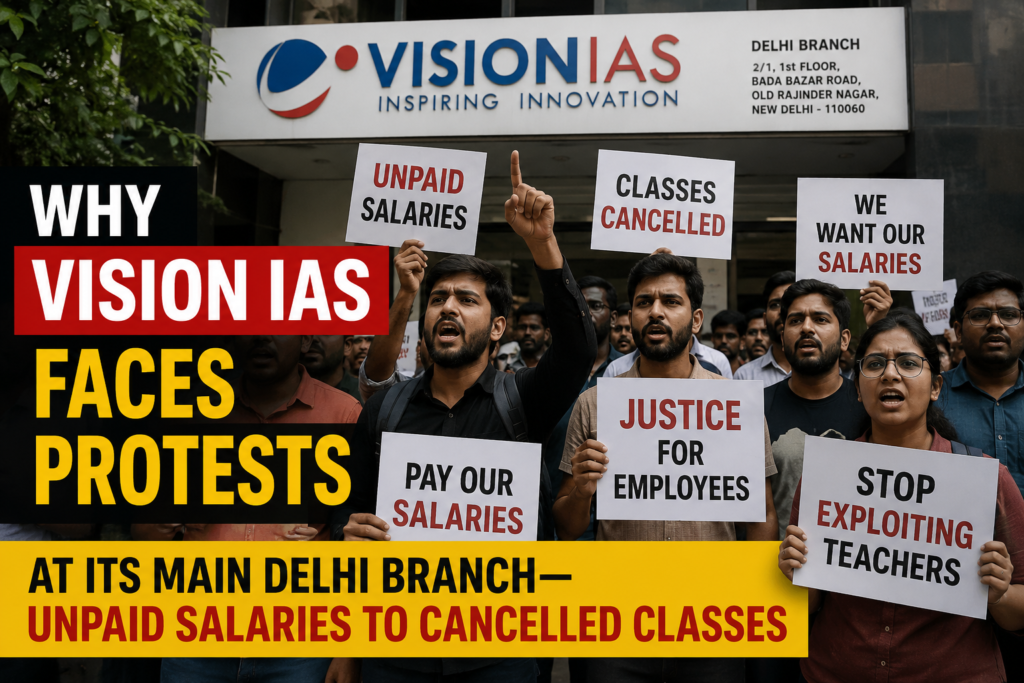
Why Vision IAS Faces Protests at Its Main Delhi Branch
Vision IAS, one of India’s most recognized coaching institutes for UPSC Civil Services preparation, has recently found itself at the center of controversy after protests reportedly erupted outside its main Delhi branch. The demonstrations have drawn widespread attention on social media and among UPSC aspirants, with allegations ranging from unpaid employee salaries to repeated class cancellations and administrative issues. The developments have raised concerns among current students, faculty members, and prospective aspirants who rely on reputed coaching institutes for structured preparation. While the institute has built a strong reputation over the years for producing successful civil servants, the recent events have sparked debates regarding transparency, employee welfare, and the overall functioning of large coaching organizations. As discussions continue, many students are seeking clarity regarding the authenticity of these claims and their potential impact on ongoing academic sessions.
Overview of the Vision IAS Protest
| Particular | Details |
|---|---|
| Institute | Vision IAS |
| Location | Main Delhi Branch |
| Issue | Alleged unpaid salaries and cancelled classes |
| People Involved | Employees, Faculty Members, Students |
| Nature of Protest | Peaceful demonstrations and demands for resolution |
| Student Concern | Academic disruption |
| Current Status | Reports and discussions continue; official clarification may evolve |
What Triggered the Vision IAS Protest?
The protest reportedly began after several employees and faculty members raised concerns regarding delayed or unpaid salaries. According to individuals participating in the demonstrations, salary payments had allegedly been pending for several weeks or months, creating financial difficulties for teaching and non-teaching staff. Alongside salary-related concerns, students also complained about repeated cancellation of scheduled classes without sufficient notice or timely replacement sessions. These issues gradually escalated into organized protests outside the institute’s Delhi headquarters, where employees and students demanded immediate action from the management. Although various reports have circulated online, official confirmations regarding every allegation continue to emerge, making it important for students to rely on verified updates rather than speculation.
Allegations of Unpaid Salaries
One of the primary reasons behind the protest revolves around allegations that several employees had not received their salaries on time. Faculty members, administrative staff, and support employees reportedly expressed dissatisfaction over delayed payments, stating that regular salary disbursement is essential for maintaining professional commitments and personal financial stability. Employees allegedly claimed that repeated assurances regarding salary release were not fulfilled according to expectations, prompting them to stage protests. While these allegations have attracted significant attention, it is important to distinguish between claims made during demonstrations and officially verified financial statements released by the organization.
Cancelled Classes Added to Student Frustration
Another major concern raised during the protests relates to the cancellation of classroom sessions. Students reportedly experienced multiple instances where scheduled lectures were cancelled or postponed, sometimes at short notice. UPSC preparation follows a rigorous timetable, and unexpected disruptions can affect syllabus completion, revision schedules, and overall exam readiness. Aspirants preparing for one of India’s most competitive examinations invest substantial amounts of time and money in coaching programs, making consistency in academic delivery an important expectation. Reports suggest that dissatisfaction among students increased as cancelled classes coincided with ongoing administrative concerns.
How Students Reacted
Many students expressed concern over the uncertainty surrounding their classes and future academic schedules. Some reportedly joined demonstrations or voiced their opinions through social media platforms, requesting timely communication from the institute regarding lecture schedules, faculty availability, and academic continuity. Others emphasized that they chose Vision IAS because of its reputation for quality education and expected uninterrupted guidance throughout their UPSC preparation journey. Several students also sought reassurance that the reported issues would not affect upcoming batches or examination-focused programs.
Impact on UPSC Aspirants
The controversy has naturally generated anxiety among UPSC aspirants because preparation for the Civil Services Examination demands consistency and disciplined study. Missing classes or experiencing interruptions in coaching can create gaps in syllabus coverage, particularly for students depending heavily on classroom teaching. Aspirants often plan their study schedules months in advance, aligning coaching lectures with self-study, answer writing practice, current affairs preparation, and revision. Any disruption in this ecosystem may force students to modify their preparation strategies, making institutional stability an important factor during examination preparation.
Vision IAS Reputation Before the Controversy
Before these reports surfaced, Vision IAS had established itself as one of India’s leading UPSC coaching institutes. Known for its classroom programs, test series, current affairs magazines, interview guidance, and online learning initiatives, the institute has consistently attracted thousands of civil services aspirants every year. Many successful UPSC candidates have acknowledged using Vision IAS study material during their preparation. Its popularity has largely been built on comprehensive content, experienced faculty, and structured guidance, making the recent controversy particularly noteworthy within the education sector.
Role of Social Media in Amplifying the Issue
Social media platforms have played a significant role in bringing the protests into public discussion. Videos, photographs, and personal accounts shared online quickly gained attention among UPSC aspirants across India. Hashtags related to Vision IAS began trending in educational communities, leading many students to seek clarification regarding the actual situation. While social media enables rapid dissemination of information, it also increases the risk of misinformation, making verification through credible news reports and official statements essential before drawing conclusions.
Employee Welfare in the Coaching Industry
The Vision IAS controversy has also reignited discussions regarding employee welfare within India’s coaching industry. Large educational institutions employ hundreds of teachers, researchers, content developers, administrative professionals, counselors, and technical staff. Timely salary payments, transparent employment policies, and effective communication are fundamental for maintaining employee morale and ensuring uninterrupted educational services. Industry experts argue that employee satisfaction directly influences classroom quality, student support, and institutional reputation.
Importance of Academic Continuity
Academic continuity remains one of the most critical expectations of students enrolled in coaching institutes. UPSC preparation follows strict timelines covering prelims, mains, optional subjects, essay writing, ethics, interview preparation, and current affairs. Repeated class cancellations can create uncertainty and compel students to rely more heavily on self-study or alternative educational resources. Coaching institutes therefore face the responsibility of ensuring backup faculty arrangements, timely notifications, and transparent communication whenever unavoidable disruptions occur.
Management Response and Official Clarification
As public attention increased, many students awaited an official response from Vision IAS management regarding the allegations. Institutions facing similar situations generally issue public statements explaining operational challenges, corrective measures, and future plans for restoring normal academic functioning. Until comprehensive official communication addresses every allegation, students are advised to consider verified information from credible sources instead of relying solely on unverified online discussions. Transparency from institutional leadership often plays an essential role in rebuilding trust among employees and students.
Financial Challenges in the Education Sector
Private educational institutions sometimes encounter financial pressures arising from operational expenses, infrastructure costs, technology investments, marketing, faculty remuneration, and changing enrollment trends. While leading coaching institutes often manage large student populations, financial management remains crucial for sustaining quality education. Experts believe that effective budgeting, transparent administration, and responsible financial planning are necessary to avoid disruptions affecting both employees and learners.
How Aspirants Should Respond
Students currently enrolled in coaching institutes experiencing administrative challenges should remain calm and focus on maintaining their preparation schedule. Depending entirely on classroom lectures may increase vulnerability during unexpected disruptions. Aspirants are encouraged to continue studying standard reference books, NCERTs, government reports, previous year question papers, and current affairs independently while awaiting official updates from their coaching institute. Maintaining a balanced study routine ensures that temporary institutional issues do not significantly impact examination performance.
Choosing a Coaching Institute Carefully
The recent developments highlight the importance of evaluating coaching institutes beyond promotional advertisements and success stories. Prospective students should examine faculty stability, institutional transparency, student feedback, academic consistency, course structure, and grievance redressal mechanisms before enrolling. Speaking with current students, reviewing verified testimonials, and understanding refund or replacement policies can help aspirants make informed decisions regarding their UPSC preparation.
Broader Impact on India’s Coaching Industry
The controversy has sparked broader conversations regarding governance standards within India’s rapidly growing coaching industry. As coaching institutions continue expanding across multiple cities and digital platforms, expectations surrounding accountability, employee welfare, financial transparency, and student satisfaction are increasing. Educational experts suggest that stronger internal management systems, improved communication channels, and greater operational transparency can strengthen trust between institutions, employees, and students while minimizing the likelihood of similar controversies in the future.
FAQs
1. Why is Vision IAS facing protests?
The protests are reportedly linked to allegations of unpaid employee salaries and repeated cancellation of classes, leading to dissatisfaction among staff and students.
2. Where did the protests take place?
According to reports, the demonstrations were held outside Vision IAS’s main Delhi branch.
3. Were students affected by the controversy?
Yes, several students reportedly expressed concerns about cancelled classes and possible disruptions to their UPSC preparation.
4. Has Vision IAS officially responded?
Students should refer to official communications from Vision IAS and credible news sources for the latest updates, as responses may evolve over time.
5. Will UPSC preparation be affected?
The impact depends on individual batches and institutional arrangements. Students are encouraged to continue self-study while monitoring official announcements.